The AFI Research Institute set out to design a mint schedule that is simple enough to audit, steady enough to plan around, and intelligent enough to respond to real network conditions. Hybrid Emissions is the result. It marries a clear, deterministic base with a bounded, data-driven trim. The shape is legible, the math is reproducible, and the incentives line up with the work we want the network to produce.
The core schedule
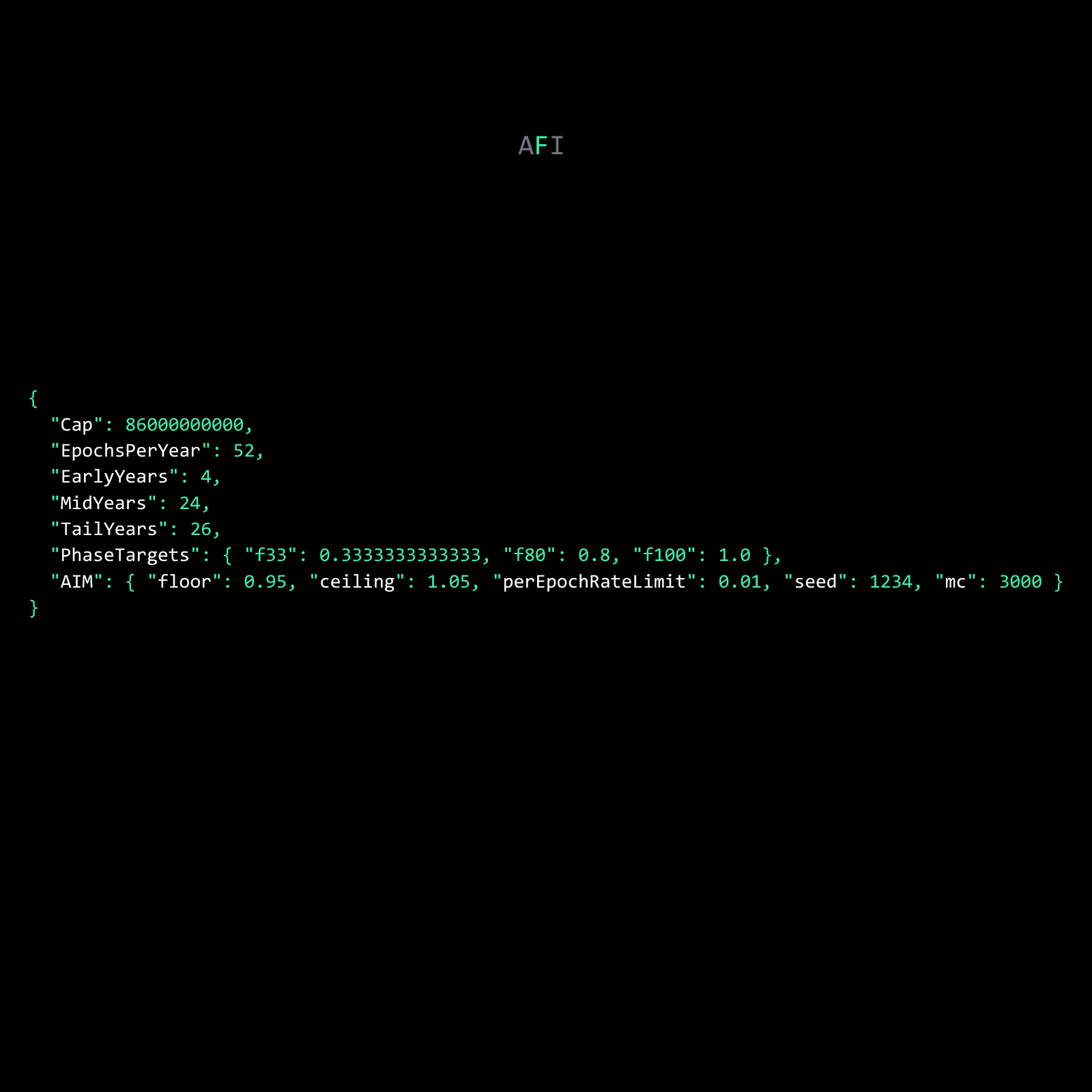
AFI mints weekly, fifty-two epochs per year, toward a fixed cap of 86 billion AFI. The base schedule unfolds in three phases that reflect how participation and utility typically mature.
Early: about four years to the first third of supply. Per-epoch emissions are constant at 137,820,512.8 AFI, which supports bootstrapping and early contributor depth. By week 208 the network reaches roughly 33⅓% of the cap.
Mid: about twenty-four additional years to the eighty percent mark. Emissions step down to about 32,158,119.66 AFI per epoch, creating long, predictable runway for growth and refinement. Around week 1,457 the total crosses 80%.
Tail: the final twenty-six years to completion. Emissions step down once more to about 12,721,893.49 AFI per epoch, rewarding maintenance, curation, and hardening until the network reaches 100% at week 2,808, about fifty-four years from start.
Nothing in this foundation is stochastic. In Wolfram Mathematica, we carry the arithmetic in exact rationals and verify three invariants: the sum of all emissions equals 86,000,000,000, the epoch counts add to 2,808, and the cumulative series reaches the cap exactly at the end of the final phase. These checks guard against drift and make audits straightforward.
The intelligent trim
Real networks breathe. Quality, reliability, and coverage rise and fall as people join, leave, and learn. We reflect that reality with AIM, the Agentic Index Multiplier. Each epoch’s final mint is
AIM is derived from a measured index of network health and contribution quality. To keep supply honest and avoid whiplash, we bound AIM to a narrow corridor, for example 0.95 to 1.05, and apply a small rate limit so changes drift rather than jump. This design preserves three properties that matter:
Auditability: one line explains the mint each week.
Integrity: AIM is centered on one, so the long-run total approaches the same cap as the base schedule.
Responsiveness: when the network under-delivers, the mint eases; when it outperforms, the mint nudges upward within the bound.
AIM does not turn AFI into a basket of non-fungible claims. AFI remains fungible. The multiplier simply sizes the epoch reward pool. Qualified signals share that pool according to protocol rules, with receipts linked to on-chain anchors and durable content hashes so that an explorer can trace work to reward without compromising fungibility.
Methods and reproducibility
We built the schedule and figures WL-native in Wolfram Mathematica. The package defines a small surface:
DefaultParams[] specifies the cap, phase lengths, and cadence.
SimAFI[] returns the per-epoch series and the cumulative curve.
CumulativePlot[] draws the curve with milestone guides and the cap line.
ExportBasics[] writes CSV, JSON, SVG, and PNG artifacts.
Because the emission math runs in exact form first, the CSV and JSON you ship to production match the charts you publish. No silent rounding, no surprises.
For the adaptive layer we tested behavior with Monte Carlo scenario runs. We simulate index paths that reflect plausible ranges for coverage, reliability, and novelty, apply the same clipping and rate-limit used in production, then inspect the distribution of AIM across epochs and scenarios. The result is a tight center on one with a light right tail toward the bound. In expectation, the policy does not inflate the supply. In practice, it times issuance to the cadence of real work.
Governance and audit
Hybrid Emissions is purposely small to govern. Phase lengths, the AIM corridor, and the rate limit are scalar parameters with measurable effects. Proposals can present both the change and the Monte Carlo evidence for its impact. Audits are likewise simple: recalculate the per-epoch base, pull the recorded AIM values and their inputs, and verify that the published totals match the artifacts produced by the reference package.
The explorer binds the story together. On-chain anchors provide existence and sequence. IPFS or Arweave carry durable summaries and hashes. MongoDB holds detailed, query-friendly records for research and model training, tethered to those anchors. Users see supply, provenance, and validation without turning the currency into a set of one-off receipts.
What the figures show
Figure 1. Cumulative supply to the 86B cap.
A smooth S-curve with vertical guides at the one-third and eighty percent marks and a dotted cap line at one hundred percent. The 100% label is fully visible, which sounds trivial and is not, as anyone who has clipped a y-axis will attest.
Figure 2. Yearly minted by phase.
Three flat shelves that correspond to the three constant per-epoch levels. Early years sit near 7.17 billion per year, mid years near 1.67 billion, and tail years near 0.662 billion. This figure translates the weekly cadence into a budget people can feel.
Figure 3. An illustrative AFI Index and its smoothing.
A synthetic index and a short moving average in the moderate band where we expect a young network to live. The point is not to predict a path, but to show the transformation that leads to AIM.
Figure 4. Mapping from index to AIM.
The same illustrative path, after clipping and a gentle rate limit. The multiplier hugs one, moves deliberately, and respects the corridor.
Figure 5. AIM distribution across scenarios.
A Monte Carlo histogram that centers on one, with only a small portion near the upper bound. It shows that the adaptive layer behaves like a metronome, not a siren.
Why this matters
A mint schedule is not just a curve. It is a public commitment to how a community values time, contribution, and stability. The deterministic core in Hybrid Emissions gives contributors and integrators a stable base for decades. The adaptive trim ties issuance to real activity without inviting gamesmanship or obscurity. The Wolfram Mathematica implementation gives reviewers and partners a way to reproduce everything we claim, down to the last epoch.
In short, we believe Hybrid Emissions stands on its own because it honors three values that define the AFI Research Institute: clarity of design, evidence over narrative, and incentives that reward insight and care. If you read the CSV, you are reading the policy. If you run the package, you will draw the same figures. If you build on AFI, you can plan around it.

The AFI Research Institute set out to design a mint schedule that is simple enough to audit, steady enough to plan around, and intelligent enough to respond to real network conditions. Hybrid Emissions is the result. It marries a clear, deterministic base with a bounded, data-driven trim. The shape is legible, the math is reproducible, and the incentives line up with the work we want the network to produce.
The core schedule
AFI mints weekly, fifty-two epochs per year, toward a fixed cap of 86 billion AFI. The base schedule unfolds in three phases that reflect how participation and utility typically mature.
Early: about four years to the first third of supply. Per-epoch emissions are constant at 137,820,512.8 AFI, which supports bootstrapping and early contributor depth. By week 208 the network reaches roughly 33⅓% of the cap.
Mid: about twenty-four additional years to the eighty percent mark. Emissions step down to about 32,158,119.66 AFI per epoch, creating long, predictable runway for growth and refinement. Around week 1,457 the total crosses 80%.
Tail: the final twenty-six years to completion. Emissions step down once more to about 12,721,893.49 AFI per epoch, rewarding maintenance, curation, and hardening until the network reaches 100% at week 2,808, about fifty-four years from start.
Nothing in this foundation is stochastic. In Wolfram Mathematica, we carry the arithmetic in exact rationals and verify three invariants: the sum of all emissions equals 86,000,000,000, the epoch counts add to 2,808, and the cumulative series reaches the cap exactly at the end of the final phase. These checks guard against drift and make audits straightforward.
The intelligent trim
Real networks breathe. Quality, reliability, and coverage rise and fall as people join, leave, and learn. We reflect that reality with AIM, the Agentic Index Multiplier. Each epoch’s final mint is
AIM is derived from a measured index of network health and contribution quality. To keep supply honest and avoid whiplash, we bound AIM to a narrow corridor, for example 0.95 to 1.05, and apply a small rate limit so changes drift rather than jump. This design preserves three properties that matter:
Auditability: one line explains the mint each week.
Integrity: AIM is centered on one, so the long-run total approaches the same cap as the base schedule.
Responsiveness: when the network under-delivers, the mint eases; when it outperforms, the mint nudges upward within the bound.
AIM does not turn AFI into a basket of non-fungible claims. AFI remains fungible. The multiplier simply sizes the epoch reward pool. Qualified signals share that pool according to protocol rules, with receipts linked to on-chain anchors and durable content hashes so that an explorer can trace work to reward without compromising fungibility.
Methods and reproducibility
We built the schedule and figures WL-native in Wolfram Mathematica. The package defines a small surface:
DefaultParams[] specifies the cap, phase lengths, and cadence.
SimAFI[] returns the per-epoch series and the cumulative curve.
CumulativePlot[] draws the curve with milestone guides and the cap line.
ExportBasics[] writes CSV, JSON, SVG, and PNG artifacts.
Because the emission math runs in exact form first, the CSV and JSON you ship to production match the charts you publish. No silent rounding, no surprises.
For the adaptive layer we tested behavior with Monte Carlo scenario runs. We simulate index paths that reflect plausible ranges for coverage, reliability, and novelty, apply the same clipping and rate-limit used in production, then inspect the distribution of AIM across epochs and scenarios. The result is a tight center on one with a light right tail toward the bound. In expectation, the policy does not inflate the supply. In practice, it times issuance to the cadence of real work.
Governance and audit
Hybrid Emissions is purposely small to govern. Phase lengths, the AIM corridor, and the rate limit are scalar parameters with measurable effects. Proposals can present both the change and the Monte Carlo evidence for its impact. Audits are likewise simple: recalculate the per-epoch base, pull the recorded AIM values and their inputs, and verify that the published totals match the artifacts produced by the reference package.
The explorer binds the story together. On-chain anchors provide existence and sequence. IPFS or Arweave carry durable summaries and hashes. MongoDB holds detailed, query-friendly records for research and model training, tethered to those anchors. Users see supply, provenance, and validation without turning the currency into a set of one-off receipts.
What the figures show
Figure 1. Cumulative supply to the 86B cap.
A smooth S-curve with vertical guides at the one-third and eighty percent marks and a dotted cap line at one hundred percent. The 100% label is fully visible, which sounds trivial and is not, as anyone who has clipped a y-axis will attest.
Figure 2. Yearly minted by phase.
Three flat shelves that correspond to the three constant per-epoch levels. Early years sit near 7.17 billion per year, mid years near 1.67 billion, and tail years near 0.662 billion. This figure translates the weekly cadence into a budget people can feel.
Figure 3. An illustrative AFI Index and its smoothing.
A synthetic index and a short moving average in the moderate band where we expect a young network to live. The point is not to predict a path, but to show the transformation that leads to AIM.
Figure 4. Mapping from index to AIM.
The same illustrative path, after clipping and a gentle rate limit. The multiplier hugs one, moves deliberately, and respects the corridor.
Figure 5. AIM distribution across scenarios.
A Monte Carlo histogram that centers on one, with only a small portion near the upper bound. It shows that the adaptive layer behaves like a metronome, not a siren.
Why this matters
A mint schedule is not just a curve. It is a public commitment to how a community values time, contribution, and stability. The deterministic core in Hybrid Emissions gives contributors and integrators a stable base for decades. The adaptive trim ties issuance to real activity without inviting gamesmanship or obscurity. The Wolfram Mathematica implementation gives reviewers and partners a way to reproduce everything we claim, down to the last epoch.
In short, we believe Hybrid Emissions stands on its own because it honors three values that define the AFI Research Institute: clarity of design, evidence over narrative, and incentives that reward insight and care. If you read the CSV, you are reading the policy. If you run the package, you will draw the same figures. If you build on AFI, you can plan around it.
The AFI Research Institute set out to design a mint schedule that is simple enough to audit, steady enough to plan around, and intelligent enough to respond to real network conditions. Hybrid Emissions is the result. It marries a clear, deterministic base with a bounded, data-driven trim. The shape is legible, the math is reproducible, and the incentives line up with the work we want the network to produce.
The core schedule
AFI mints weekly, fifty-two epochs per year, toward a fixed cap of 86 billion AFI. The base schedule unfolds in three phases that reflect how participation and utility typically mature.
Early: about four years to the first third of supply. Per-epoch emissions are constant at 137,820,512.8 AFI, which supports bootstrapping and early contributor depth. By week 208 the network reaches roughly 33⅓% of the cap.
Mid: about twenty-four additional years to the eighty percent mark. Emissions step down to about 32,158,119.66 AFI per epoch, creating long, predictable runway for growth and refinement. Around week 1,457 the total crosses 80%.
Tail: the final twenty-six years to completion. Emissions step down once more to about 12,721,893.49 AFI per epoch, rewarding maintenance, curation, and hardening until the network reaches 100% at week 2,808, about fifty-four years from start.
Nothing in this foundation is stochastic. In Wolfram Mathematica, we carry the arithmetic in exact rationals and verify three invariants: the sum of all emissions equals 86,000,000,000, the epoch counts add to 2,808, and the cumulative series reaches the cap exactly at the end of the final phase. These checks guard against drift and make audits straightforward.
The intelligent trim
Real networks breathe. Quality, reliability, and coverage rise and fall as people join, leave, and learn. We reflect that reality with AIM, the Agentic Index Multiplier. Each epoch’s final mint is
AIM is derived from a measured index of network health and contribution quality. To keep supply honest and avoid whiplash, we bound AIM to a narrow corridor, for example 0.95 to 1.05, and apply a small rate limit so changes drift rather than jump. This design preserves three properties that matter:
Auditability: one line explains the mint each week.
Integrity: AIM is centered on one, so the long-run total approaches the same cap as the base schedule.
Responsiveness: when the network under-delivers, the mint eases; when it outperforms, the mint nudges upward within the bound.
AIM does not turn AFI into a basket of non-fungible claims. AFI remains fungible. The multiplier simply sizes the epoch reward pool. Qualified signals share that pool according to protocol rules, with receipts linked to on-chain anchors and durable content hashes so that an explorer can trace work to reward without compromising fungibility.
Methods and reproducibility
We built the schedule and figures WL-native in Wolfram Mathematica. The package defines a small surface:
DefaultParams[] specifies the cap, phase lengths, and cadence.
SimAFI[] returns the per-epoch series and the cumulative curve.
CumulativePlot[] draws the curve with milestone guides and the cap line.
ExportBasics[] writes CSV, JSON, SVG, and PNG artifacts.
Because the emission math runs in exact form first, the CSV and JSON you ship to production match the charts you publish. No silent rounding, no surprises.
For the adaptive layer we tested behavior with Monte Carlo scenario runs. We simulate index paths that reflect plausible ranges for coverage, reliability, and novelty, apply the same clipping and rate-limit used in production, then inspect the distribution of AIM across epochs and scenarios. The result is a tight center on one with a light right tail toward the bound. In expectation, the policy does not inflate the supply. In practice, it times issuance to the cadence of real work.
Governance and audit
Hybrid Emissions is purposely small to govern. Phase lengths, the AIM corridor, and the rate limit are scalar parameters with measurable effects. Proposals can present both the change and the Monte Carlo evidence for its impact. Audits are likewise simple: recalculate the per-epoch base, pull the recorded AIM values and their inputs, and verify that the published totals match the artifacts produced by the reference package.
The explorer binds the story together. On-chain anchors provide existence and sequence. IPFS or Arweave carry durable summaries and hashes. MongoDB holds detailed, query-friendly records for research and model training, tethered to those anchors. Users see supply, provenance, and validation without turning the currency into a set of one-off receipts.
What the figures show
Figure 1. Cumulative supply to the 86B cap.
A smooth S-curve with vertical guides at the one-third and eighty percent marks and a dotted cap line at one hundred percent. The 100% label is fully visible, which sounds trivial and is not, as anyone who has clipped a y-axis will attest.
Figure 2. Yearly minted by phase.
Three flat shelves that correspond to the three constant per-epoch levels. Early years sit near 7.17 billion per year, mid years near 1.67 billion, and tail years near 0.662 billion. This figure translates the weekly cadence into a budget people can feel.
Figure 3. An illustrative AFI Index and its smoothing.
A synthetic index and a short moving average in the moderate band where we expect a young network to live. The point is not to predict a path, but to show the transformation that leads to AIM.
Figure 4. Mapping from index to AIM.
The same illustrative path, after clipping and a gentle rate limit. The multiplier hugs one, moves deliberately, and respects the corridor.
Figure 5. AIM distribution across scenarios.
A Monte Carlo histogram that centers on one, with only a small portion near the upper bound. It shows that the adaptive layer behaves like a metronome, not a siren.
Why this matters
A mint schedule is not just a curve. It is a public commitment to how a community values time, contribution, and stability. The deterministic core in Hybrid Emissions gives contributors and integrators a stable base for decades. The adaptive trim ties issuance to real activity without inviting gamesmanship or obscurity. The Wolfram Mathematica implementation gives reviewers and partners a way to reproduce everything we claim, down to the last epoch.
In short, we believe Hybrid Emissions stands on its own because it honors three values that define the AFI Research Institute: clarity of design, evidence over narrative, and incentives that reward insight and care. If you read the CSV, you are reading the policy. If you run the package, you will draw the same figures. If you build on AFI, you can plan around it.